Can Silicone Boots Fit YETI Bottles for Wholesale Outdoor Equipment Lines?
If you buy wholesale outdoor gear, you already know this problem. You stock a premium bottle line, and then customers complain it does not fit their cupholder. That one complaint can kill a reorder.
Silicone boots can fit YETI bottles for wholesale outdoor equipment lines. The right silicone boot reduces the bottle's outer diameter just enough to sit inside a standard vehicle cupholder.1 It also protects the bottle during transit and adds grip. For wholesale buyers, this turns one SKU into a two-product bundle.
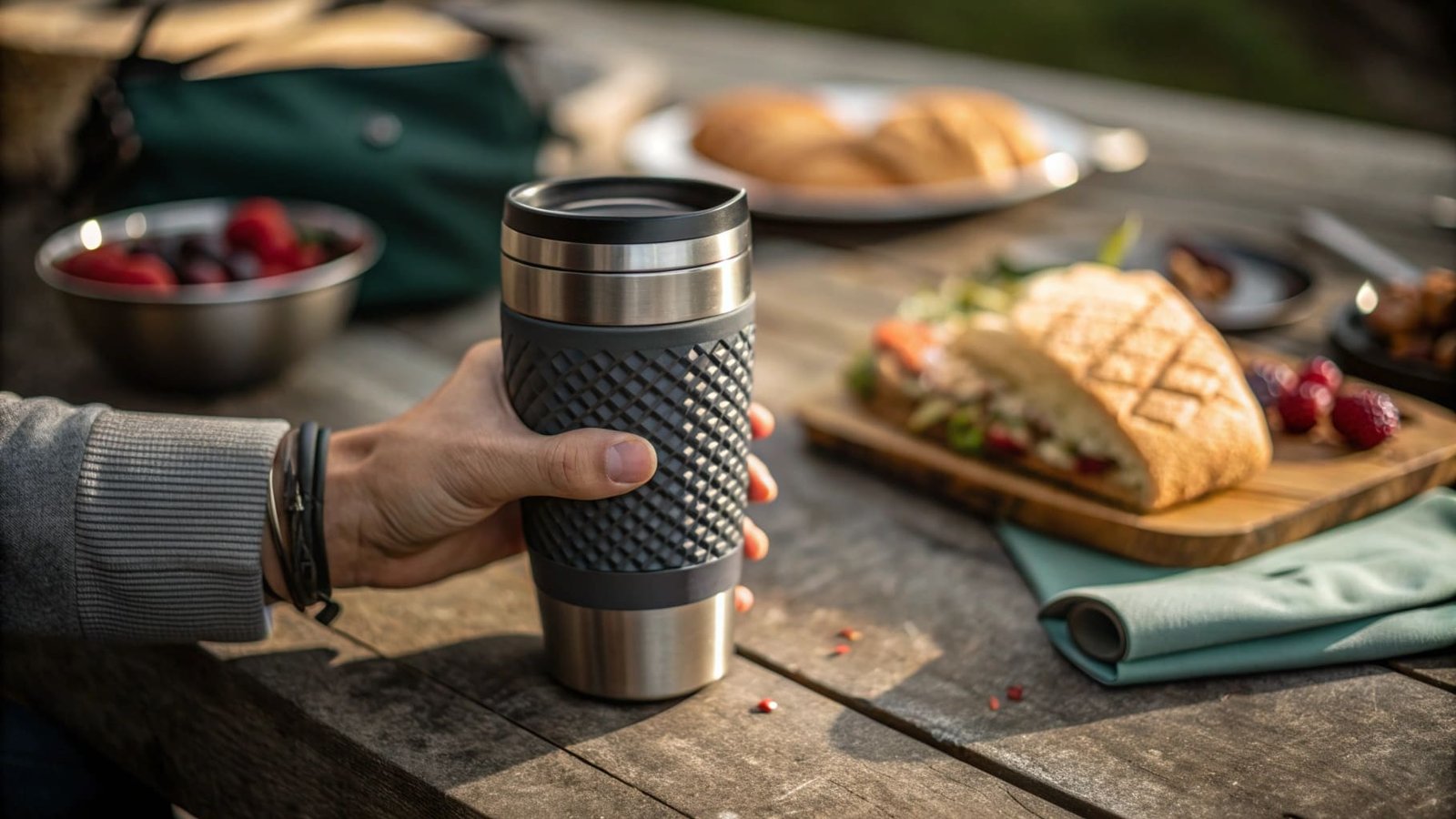
This matters more than it looks. I work with wholesale buyers across North America and Europe every day. The ones who build strong outdoor equipment lines are not just buying bottles. They are buying a system. A silicone boot is a small part of that system, but it solves real problems that show up at the point of sale. Let me break down the three questions I hear most from buyers in this space.
What YETI Rambler Fits in Cupholders?
You have a customer who loves their YETI Rambler. Then they try to put it in their car. It does not fit. Now they are unhappy, and that reflects on you as the distributor.
Most standard vehicle cupholders are between 3.1 inches and 3.5 inches in diameter.2 The YETI Rambler 20 oz tumbler is about 3.5 inches at its widest base.3 The 30 oz is similar. Without a silicone boot, the fit is tight or impossible in many vehicles.
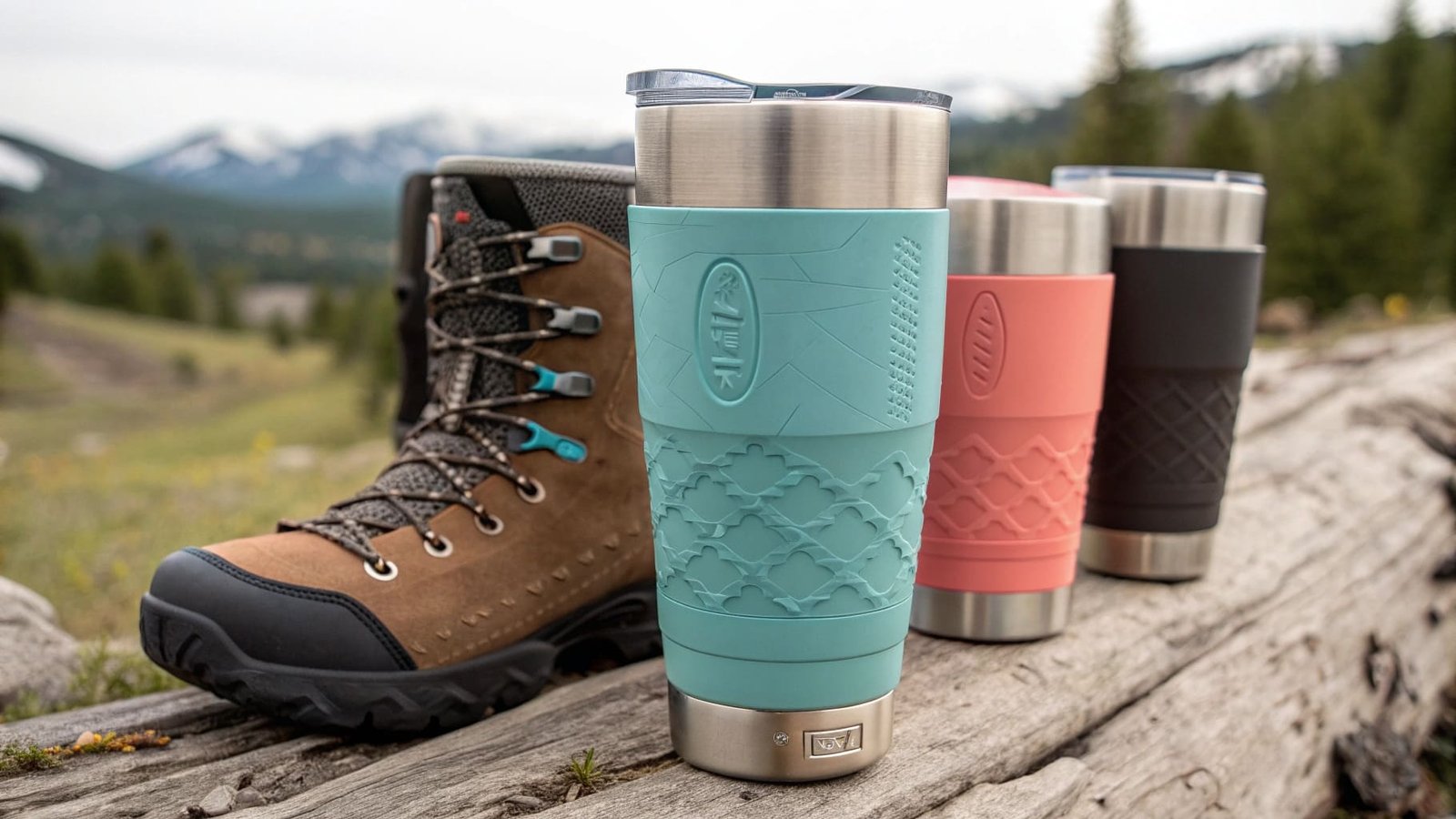
A silicone boot changes this. Here is how it works from a product design perspective.
How Does Silicone Shore Hardness Affect Cupholder Fit?
The silicone material used in the boot needs to be firm enough to hold its shape but soft enough to compress slightly when the bottle enters the cupholder. This is where Shore A hardness becomes important. I produce silicone tumbler boots using food-grade silicone in the 40 to 60 Shore A range. At 40 Shore A, the boot is soft and compresses easily. At 60 Shore A, it is firmer and holds the bottle higher in the cupholder.4
For wholesale buyers building an outdoor equipment line, the right hardness depends on your target customer. Outdoor and automotive-focused buyers tend to prefer a firmer boot, around 55 to 60 Shore A. Lifestyle and café-oriented buyers often prefer the softer feel of 40 to 50 Shore A.
| Shore A Hardness | Feel | Best Use Case |
|---|---|---|
| 40 Shore A | Very soft, easy to compress | Lifestyle, café, gym |
| 50 Shore A | Medium, good grip | General outdoor use |
| 60 Shore A | Firm, stable base | Automotive, rugged outdoor |
Beyond hardness, the boot's base diameter is the key number. A well-designed silicone boot for YETI-style tumblers targets a finished outer diameter between 3.1 and 3.3 inches. This fits the majority of standard North American and European vehicle cupholders without modification.5 For wholesale buyers, this means fewer customer complaints and stronger repeat orders. One boot design can cover multiple bottle sizes when the silicone wall thickness is adjusted, which directly reduces the number of SKUs you need to carry.
Are YETI Water Bottles Allowed on Planes?
Your customer packs their YETI for a flight. They get stopped at security. The bottle is empty, but the lid has a leftover seal ring or trapped moisture, and a TSA agent flags it. This is a real situation, and it affects how your customers feel about the products you sell them.
Empty YETI water bottles are allowed on planes under TSA rules. The bottle must be empty before passing through the security checkpoint.6 After security, your customer can fill it at a water station. The bottle itself is not the issue. The accessories attached to it sometimes are.
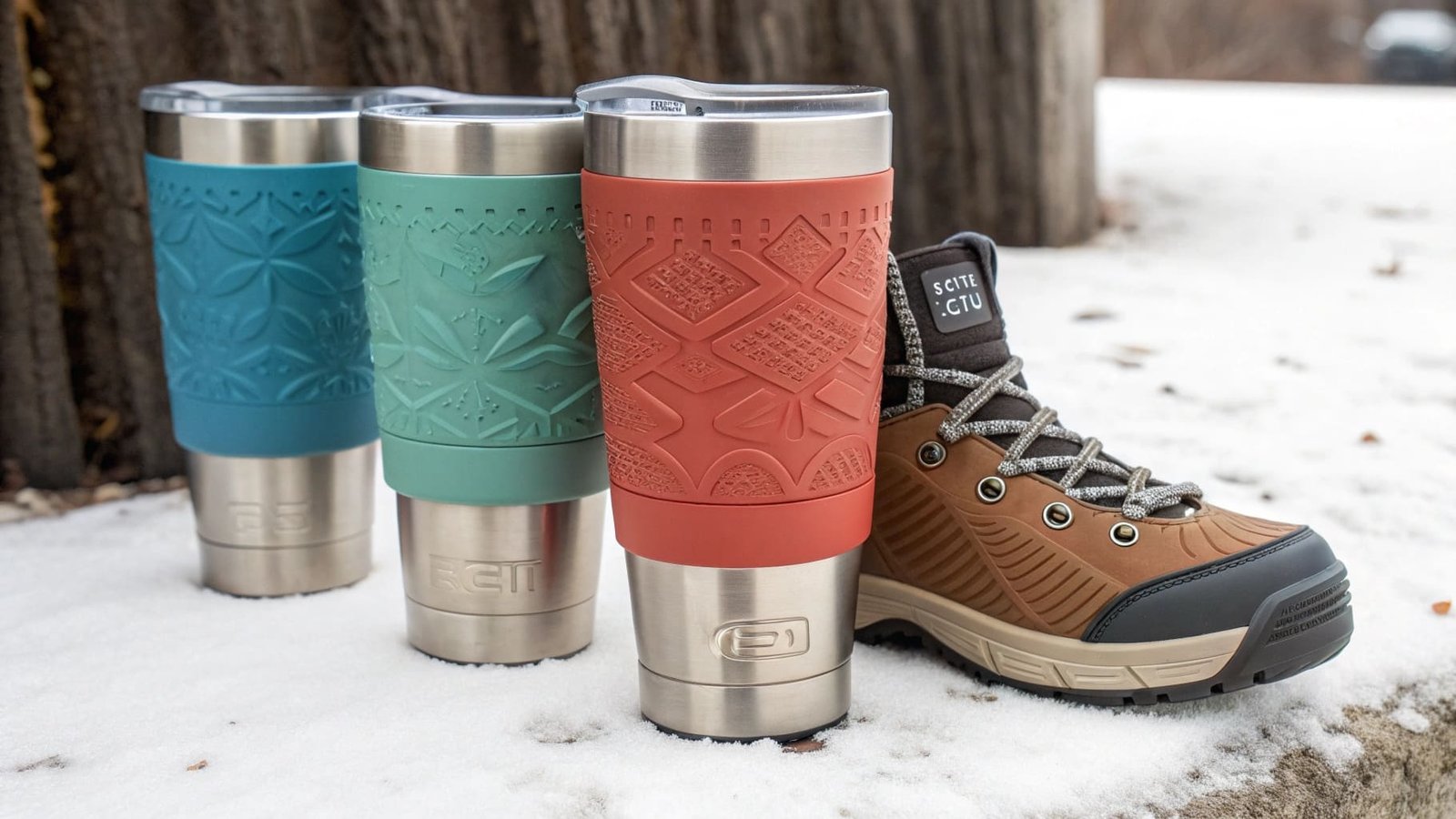
This is where silicone accessories become a wholesale conversation topic, not just a product spec.
What Silicone Accessories Travel Best with Insulated Bottles?
The TSA does not restrict silicone accessories. A silicone boot, silicone lid gasket, silicone straw plug, or silicone cup sleeve can all travel in carry-on luggage with no issue. The reason is simple. Silicone is not a liquid, gel, or aerosol. It does not fall under the 3-1-1 liquids rule.7
For wholesale buyers, this is a selling point you can pass down your retail chain. Customers who travel frequently are a strong buyer segment for insulated bottles and their accessories. They want to know their gear works at the airport, in the car, and on the trail.
| Silicone Accessory | TSA Carry-On Status | Travel Benefit |
|---|---|---|
| Silicone Tumbler Boot | Allowed | Protects bottle base during transit |
| Silicone Lid Gasket | Allowed | Prevents leaks in bag |
| Silicone Straw Hole Plug | Allowed | Seals lid opening |
| Silicone Cup Sleeve | Allowed | Adds grip on the go |
| Silicone Stretch Lid | Allowed | Covers open-top bottles |
The practical angle here is that a complete silicone accessory kit paired with a YETI-compatible bottle creates a travel-ready product bundle. I have seen wholesale buyers in Canada and the US use this bundle approach to increase their average order value at retail. The accessories are lightweight and low-cost to ship. They add perceived value without adding significant weight or logistics complexity. For a distributor who rebrands and resells into the premium outdoor market, this kind of bundle is a direct margin improvement with minimal inventory risk.
Does the YETI Colster Work for Bottles?
The YETI Colster is designed to hold cans and some short bottles.8 But your customer wants to use it with a taller water bottle. It does not fit. They ask you if there is a silicone solution. You need an answer.
The YETI Colster does not fit most standard water bottles. It is built around 12 oz and 16 oz can dimensions. A silicone sleeve or boot designed for bottles is the right product for bottle insulation, not the Colster.
This question actually opens a bigger wholesale opportunity. Let me explain.
What Is the Right Silicone Product for Bottle Insulation and Grip?
The YETI Colster fills one function: keeping canned drinks cold. For bottles, the equivalent function is served by a silicone cup sleeve or a full silicone tumbler boot. These two products serve different needs, and for a wholesale buyer building a line, understanding the difference matters.
A silicone cup sleeve wraps around the middle section of the bottle. It adds insulation between the user's hand and the bottle wall. It improves grip. It does not change the bottle's base diameter. This is a good product for lifestyle and retail channels where aesthetics and branding matter.
A silicone tumbler boot fits over the base of the bottle. It protects the bottle bottom from scratches and drops. It reduces the bottle's outer base diameter to fit cupholders. It also cushions the bottle on hard surfaces, reducing noise and wear. This is a better fit for automotive, outdoor, and rugged-use channels.
| Product | Fits Cupholder Better | Adds Insulation | Protects Base | Adds Grip |
|---|---|---|---|---|
| Silicone Cup Sleeve | No | Yes | No | Yes |
| Silicone Tumbler Boot | Yes | Slightly | Yes | Yes |
| YETI Colster | For cans only | Yes | No | Yes |
For wholesale buyers, this comparison is useful for product selection and for training your sales team. The customer who asks about the Colster is really asking: "How do I keep my bottle protected and easy to use?" The silicone tumbler boot answers that question more completely than the Colster does for bottle users.
At silijoy, I produce both silicone cup sleeves and silicone tumbler boots with customizable dimensions and branding options. For buyers who distribute under their own label in North America or Europe, these products allow you to offer a branded accessory line without designing from scratch. The tooling is already built. You specify your size, color, and logo, and we produce to your order.
Conclusion
Silicone boots fit YETI-style bottles, solve cupholder problems, travel freely, and outperform the Colster for bottle protection. For wholesale buyers, they are a low-risk, high-value addition to any outdoor equipment line.
-
"Evolution of Shore Hardness under Uniaxial Tension/Compression ...", https://pmc.ncbi.nlm.nih.gov/articles/PMC9697891/. A citation should show that elastomeric silicone components can compress under contact pressure and that cupholder compatibility depends on the effective outside diameter of the inserted object; this supports the design rationale, although it does not independently verify any specific boot model. Evidence role: mechanism; source type: research. Supports: A source should support that silicone elastomers can deform under load and that fit depends on effective diameter and compression, while a separate automotive source may contextualize common cupholder dimensions.. Scope note: Contextual support only; it would not prove that every silicone boot reduces fit diameter or fits every YETI bottle. ↩
-
"Cup holder - Wikipedia", https://en.wikipedia.org/wiki/Cup_holder. An automotive design or standards reference should be cited for the range of common cupholder diameters, because the stated 3.1–3.5 inch interval is a dimensional generalization rather than a universal specification. Evidence role: statistic; source type: institution. Supports: A standards organization, automotive design reference, or ergonomic study should support the stated range or explain typical passenger-vehicle cupholder dimensions.. Scope note: Vehicle cupholder dimensions vary by model year, manufacturer, and market, so the source may only establish a common range. ↩
-
"YETI Rambler 20 oz Tumbler with MagSlider Lid", https://www.yeti.com/drinkware/tumblers/rambler-20oz.html. YETI’s published product specifications, or another documented measurement source, should be cited to verify the approximate diameter of the Rambler 20 oz tumbler. Evidence role: case_reference; source type: other. Supports: The source should provide official or documented dimensions for the YETI Rambler 20 oz tumbler.. Scope note: Product dimensions can change across generations or lid configurations, so the citation should correspond to the model discussed. ↩
-
"How to Choose the Right Silicone Hardness - YouTube", https://www.youtube.com/watch?v=VSGlb1DIgxw. Materials data on silicone rubber durometer should be cited to show that a 40 Shore A elastomer is generally softer and more compressible than a 60 Shore A elastomer. Evidence role: mechanism; source type: research. Supports: The source should explain the relationship between Shore A hardness values and elastomer firmness or compression response.. Scope note: The source would support relative firmness, but the exact cupholder height effect depends on boot geometry and applied load. ↩
-
"Cup holder size and depth please? - Facebook", https://www.facebook.com/groups/2023amarok/posts/594109499902796/. Automotive design data should be cited to contextualize the 3.1–3.3 inch target diameter as falling within common cupholder openings, while noting that no single dimension fits all vehicle models. Evidence role: general_support; source type: institution. Supports: A source should provide common cupholder size ranges or design guidance that makes the 3.1–3.3 inch target plausible.. Scope note: The evidence would be contextual because cupholder dimensions are not uniform across all North American and European vehicles. ↩
-
"TSA empty water bottle restriction? : r/TravelHacks - Reddit", https://www.reddit.com/r/TravelHacks/comments/18cmeuh/tsa_empty_water_bottle_restriction/. TSA guidance on carry-on liquids supports that a reusable bottle may pass through screening only when it does not contain prohibited liquid quantities. Evidence role: expert_consensus; source type: government. Supports: The source should confirm that containers holding liquids above the allowed amount are not permitted through the checkpoint, while empty containers are allowed.. Scope note: The rule concerns contents at screening rather than the YETI brand or bottle material specifically. ↩
-
"Help me settle a 3-1-1 rule debate : r/tsa - Reddit", https://www.reddit.com/r/tsa/comments/1jvolsa/help_me_settle_a_311_rule_debate/. TSA’s 3-1-1 guidance defines the restriction as applying to liquids, gels, aerosols, creams, and pastes in carry-on baggage; solid silicone accessories are outside that listed category. Evidence role: definition; source type: government. Supports: The source should define the TSA 3-1-1 rule as applying to liquids, gels, aerosols, creams, and pastes, not ordinary solid accessories.. Scope note: This supports the rule classification generally, but final screening decisions remain subject to TSA officer discretion. ↩
-
"Rambler® 12 oz Colster® Can Cooler - YETI", https://www.yeti.com/drinkware/can-insulators/colster-12oz.html. YETI’s product specifications should be cited to establish that the Colster line is marketed for cans and selected short bottles rather than as a general-purpose water-bottle holder. Evidence role: case_reference; source type: other. Supports: The source should document the Colster’s intended container sizes and use cases.. Scope note: Applicability depends on the specific Colster model, because YETI offers multiple sizes and formats. ↩