How to Keep Coffee Warm Without Electricity in Bulk Travel Mug Orders?
Sourcing bulk travel mugs? Heat retention complaints kill repeat orders fast. Here is what most buyers miss before they place a bulk order.
Double-wall vacuum insulation paired with silicone lid seals is the most proven method to keep coffee hot without electricity.1 Premium designs maintain temperatures above 60°C for 6 to 8 hours.2 No batteries. No charging. No added certification costs for international shipping.
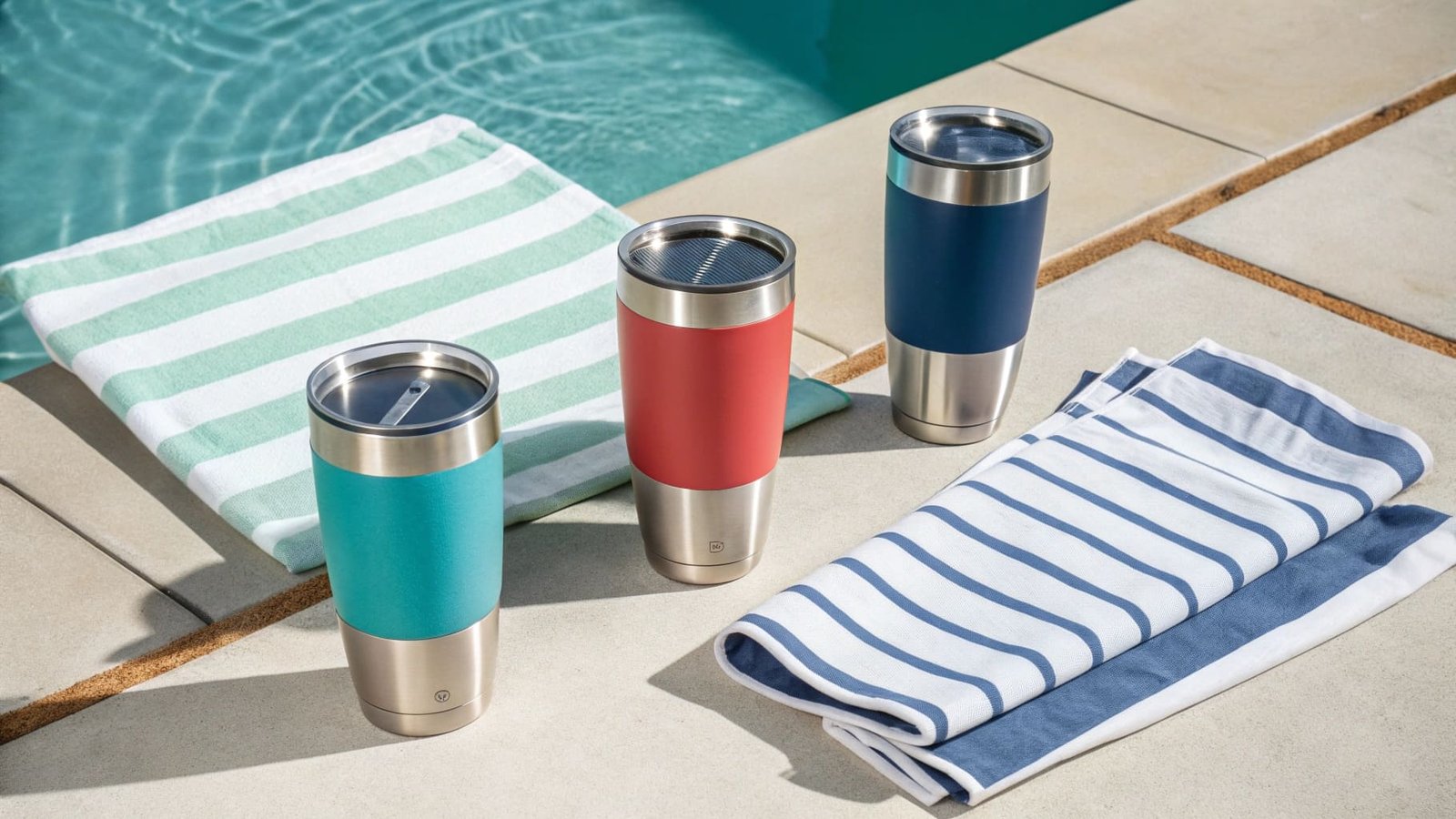
I have talked to dozens of buyers who focus entirely on price per unit. They forget to ask about thermal performance data. Then the end-user complaints come in, and the brand takes the hit. If you are sourcing travel mugs in bulk, the engineering inside the cup matters more than the logo on the outside. Let me break this down for you.
What Travel Coffee Mug Keeps Coffee Hot the Longest?
Most buyers assume all insulated mugs perform the same. They do not. The difference between a 2-hour mug and an 8-hour mug comes down to three specific design choices.
The longest heat retention comes from double-wall vacuum insulation, a silicone gasket seal at the lid contact point, and a copper-lined vacuum chamber. Together, these three features block the three main paths that heat escapes through.
Heat escapes in three ways: convection, conduction, and radiation. A vacuum layer between the inner and outer walls stops conduction.3 The silicone lid gasket creates an airtight seal that stops convection.4 A copper lining inside the vacuum chamber reflects heat back into the liquid, which reduces radiant loss.5 When all three are working together, you get real 8-hour performance, not lab-condition marketing numbers.
What makes one mug outperform another?
Here is the part most buyers do not ask about. Wall thickness ratio matters. The inner and outer stainless steel walls are typically between 0.4mm and 0.6mm thick.6 Too thin, and the vacuum seal is vulnerable to impact damage during shipping and daily use. Too thick, and the mug gets too heavy for commuters.
I always ask suppliers for their ASTM thermal performance test data before I approve a bulk order. ASTM is the standard method for measuring how long a mug holds temperature under controlled conditions.7 If a supplier cannot produce that data, that is a red flag.
One more thing most buyers overlook. Real-world performance drops 15 to 20% compared to lab test results. Why? Because liquid moves during travel. Every time the mug tips, heat stirs up and contacts the walls more. A mug rated for 8 hours in a lab test performs closer to 6.5 hours in a commuter's bag. Build that gap into your product descriptions before your customers notice it first.
| Feature | Weak Design | Premium Design |
|---|---|---|
| Wall thickness | Below 0.4mm | 0.4mm to 0.6mm |
| Lid seal material | Rubber or plastic | Food-grade silicone |
| Vacuum chamber lining | Bare steel | Copper-lined |
| Base protection | None | Silicone boot |
| Expected heat retention | 2 to 4 hours | 6 to 8 hours |
Are There Cordless Mug Warmers?
Yes, battery-powered cordless mug warmers exist. But for B2B buyers placing bulk orders for international distribution, they create more problems than they solve.
The better question is not whether a cordless warmer exists. The better question is whether your bulk order strategy needs one at all. Advanced insulation engineering removes the need for any external heat source entirely.
I looked at battery-powered mug warmers seriously about two years ago. The heat retention numbers looked appealing on paper. Then I looked at what came with that choice. Battery-powered accessories require separate safety certifications in most markets.8 In North America and Europe, that means UL or CE certification for the heating element. Each certification adds time and cost to your sourcing process. For an accessory that only extends warmth by 1 to 2 hours beyond what premium insulation already delivers, the math does not work for most bulk buyers.
Why passive insulation beats battery-powered warmers for bulk orders?
There are four practical reasons why I recommend passive insulation over cordless warmer accessories for bulk B2B sourcing.
First, passive insulation carries no battery-related shipping restrictions. Lithium battery regulations vary by carrier and destination. One rejected shipment can cost more than the savings on the unit price.
Second, silicone gasket seals require zero maintenance. A battery-powered warmer adds a component that can fail. A silicone seal either works or it does not, and its failure is visible during quality inspection before the order ships.
Third, the zero-electricity story is a strong marketing point for your end customers. Outdoor professionals, commuters, and travelers all respond well to a product that asks nothing from them except that they fill it and go. That message is clean and easy to communicate on packaging and in retail descriptions.
Fourth, passive insulation scales cleanly with bulk order sizes. There is no need to coordinate battery supply chains, manage charging accessories, or handle returns for power-related failures.
| Factor | Cordless Mug Warmer | Passive Vacuum Insulation |
|---|---|---|
| Shipping certification | Required for batteries | Not required |
| Maintenance needed | Yes, battery replacement | None |
| Failure risk | Battery or heating element | Seal wear only |
| Marketing story | Complex | Simple and strong |
| Bulk order scalability | Moderate | High |
How to Keep Coffee Hot While Traveling?
This is the question your end customers are asking. When you answer it well through product design choices, your brand builds loyalty fast.
The answer for travelers is simple. A mug with vacuum insulation, a silicone lid gasket seal, and a silicone boot base keeps coffee hot for 6 to 8 hours with no power source and no extra steps.

I have watched brands in the drinkware space lose repeat customers over one thing. The coffee was warm when they left home. It was cold when they opened the mug at their desk three hours later. That is not a marketing failure. That is a product specification failure. It starts during the sourcing process, not after the product is on the shelf.
What travel-specific features should bulk buyers look for?
When I review samples for bulk travel mug orders, I check five things specifically for travel performance. Each one addresses a real heat loss scenario that happens during daily commuting or outdoor use.
The first is the silicone lid gasket. This is the most important single component in the entire mug. It seals the lid contact point airtight. Convection, which is warm air moving out of the mug and cold air moving in, is the biggest heat loss factor during travel. A tight silicone seal blocks that path completely.
The second is the silicone boot base. This does two jobs at once. It insulates the bottom of the mug from cold surfaces like metal tables, car cup holders, and outdoor benches. Cold surfaces pull heat out of the base by conduction faster than most people expect. The silicone boot also absorbs impact from drops and daily handling, which protects the vacuum seal inside the base from damage.
The third is the wide-mouth design. This sounds counterintuitive. A wider opening seems like it would lose more heat. But wide-mouth lids are designed to seal more securely than narrow-mouth designs. They also allow less turbulence when the user drinks, which reduces heat mixing inside the mug.
The fourth is the powder-coated exterior. Bare stainless steel radiates heat outward from the outer wall. Powder coating adds a layer of insulation on the outside surface that slows that radiant transfer down.9 It also makes the mug easier to hold in cold weather without the grip slipping.
The fifth is the vacuum chamber integrity after drop testing. This is a factory-level quality check, not a feature you see on a spec sheet. I always request drop test documentation before approving bulk orders. A vacuum chamber that fails after a single drop is a defective product regardless of how well every other feature performs.
| Travel Scenario | Heat Loss Risk | Feature That Solves It |
|---|---|---|
| Mug sitting on metal table | Conduction through base | Silicone boot base |
| Drinking on the move | Convection through lid gap | Silicone lid gasket seal |
| Cold outdoor environment | Radiant loss from outer wall | Powder-coated exterior |
| Bag transport and drops | Vacuum seal damage | Drop-tested vacuum chamber |
| Long commute over 4 hours | Total insulation failure | Copper-lined vacuum chamber |
Conclusion
Bulk travel mug performance starts with vacuum insulation, silicone seals, and the right base protection. No electricity needed. Ask for ASTM data before every order.
-
"Vacuum flask - Wikipedia", https://en.wikipedia.org/wiki/Vacuum_flask. Heat-transfer references on vacuum flasks describe evacuated double walls as reducing conductive and convective heat transfer, while a well-sealed closure limits air exchange at the opening; this supports the passive-insulation mechanism rather than proving superiority for all mug designs. Evidence role: mechanism; source type: education. Supports: A neutral heat-transfer or vacuum-flask source should support that evacuated double walls reduce conductive and convective heat loss and that closures reduce air exchange.. Scope note: Contextual support; it explains the mechanism but does not rank all non-electric mug technologies. ↩
-
"The 7 Best Travel Mugs of 2026, Tested & Reviewed - Serious Eats", https://www.seriouseats.com/best-travel-mugs-5191838. Controlled thermal-retention testing of vacuum-insulated beverage containers can document temperature decay over several hours and indicate whether liquids remain above 60°C under specified laboratory conditions; such results may not predict every consumer-use scenario. Evidence role: statistic; source type: research. Supports: A controlled thermal-retention test should show whether vacuum-insulated beverage containers can remain above about 60°C for six to eight hours under defined starting-temperature and ambient-temperature conditions.. Scope note: Contextual unless the source tests the same mug geometry, lid design, fill volume, starting temperature, and ambient conditions. ↩
-
"Vacuum Insulation Panel Production with Ultralow Thermal ...", https://ui.adsabs.harvard.edu/abs/2024IJT....45..163J/abstract. Vacuum insulation reduces heat transfer by limiting gas-phase conduction and convection across the gap, although residual heat transfer can still occur through supports, seals, and radiation. Evidence role: mechanism; source type: education. Supports: A heat-transfer source should explain that vacuum gaps reduce conduction and convection by removing most gas molecules from the insulating space.. Scope note: Supports a corrected interpretation of the mechanism; it does not support the absolute wording that conduction is completely stopped. ↩
-
"Sealing cut-out lids on smoker cook chamber? - Facebook", https://www.facebook.com/groups/SmokingMeatUSA/posts/30946938738254891/. Studies of enclosure sealing and convective heat transfer show that restricting air exchange through gaps reduces convective heat loss; applied to travel mugs, the effect depends on gasket fit, lid geometry, and manufacturing tolerances. Evidence role: mechanism; source type: research. Supports: A source on gasket sealing or convective heat loss through openings should support that reducing air leakage reduces convective heat transfer from hot liquids.. Scope note: Contextual support; it does not prove that every silicone gasket is airtight or that convection is fully stopped. ↩
-
"Metal Layer to Reduce Heat Transfer | Physics Van | Illinois", https://van.physics.illinois.edu/ask/listing/42930. Radiative heat-transfer references show that low-emissivity metallic surfaces reduce thermal radiation exchange across evacuated spaces; copper coatings can serve this role when the surface condition maintains low emissivity. Evidence role: mechanism; source type: research. Supports: A heat-transfer or materials source should support that low-emissivity metallic surfaces can reduce radiative heat transfer across a vacuum gap.. Scope note: Contextual support; effectiveness depends on coating thickness, surface finish, oxidation, and mug construction. ↩
-
"Vacuum flask - Wikipedia", https://en.wikipedia.org/wiki/Vacuum_flask. Technical descriptions of double-wall stainless-steel vacuum containers can provide representative wall-thickness ranges for inner and outer shells, but such values vary by capacity, grade, forming process, and impact-resistance requirements. Evidence role: general_support; source type: other. Supports: A technical manufacturing source, standard, or patent should document typical stainless-steel wall thicknesses used in double-wall vacuum drinkware.. Scope note: Contextual support; a general source may not establish that 0.4–0.6 mm is typical across all factories or product categories. ↩
-
"[PDF] Performance Comparison of Thermal Insulated Packaging Boxes ...", https://digitalcommons.calpoly.edu/cgi/viewcontent.cgi?article=1043&context=it_fac. An ASTM standard, if applicable to insulated beverage containers, would define controlled procedures for measuring temperature retention over time, including starting temperature, ambient conditions, and measurement intervals. Evidence role: definition; source type: institution. Supports: A standards-body source should identify the relevant ASTM method and describe the controlled test conditions for measuring thermal retention.. Scope note: Requires verification of the exact ASTM designation and scope; ASTM may not be the only or universally required test method for travel mugs. ↩
-
"[PDF] Preventing Fire and/or Explosion Injury from Small and Wearable ...", https://www.osha.gov/sites/default/files/publications/SHIB011819.pdf. Regulatory guidance for electrical and battery-powered consumer products indicates that heating accessories may be subject to safety, electromagnetic-compatibility, battery, and conformity-assessment requirements before market placement. Evidence role: general_support; source type: government. Supports: Regulatory or standards sources should support that battery-powered heating products are subject to electrical safety, electromagnetic compatibility, battery, and conformity-assessment requirements depending on market.. Scope note: Contextual support; exact certification obligations vary by jurisdiction, product voltage, battery chemistry, charger design, and intended use. ↩
-
"Improvement of the Heat-Dissipating Performance of Powder ... - PMC", https://pmc.ncbi.nlm.nih.gov/articles/PMC7362242/. Materials studies show that polymer coatings can add a low-conductivity layer to metal surfaces and alter surface emissivity, affecting heat transfer by conduction and radiation; the net effect depends on coating thickness, color, roughness, and temperature difference. Evidence role: mechanism; source type: research. Supports: A materials or heat-transfer source should explain how polymer coatings affect thermal conductivity, surface emissivity, and heat exchange from metal surfaces.. Scope note: Contextual support; it does not prove that every powder-coated mug retains heat better than bare stainless steel. ↩