Why Should B2B Buyers Choose Silicone Over Neoprene for Tumbler Sleeves?
You are losing customers and you do not even know why. The problem might be sitting right in your product line — and it starts with the sleeve.
Silicone tumbler sleeves outperform neoprene in durability, safety compliance, and design flexibility. They meet FDA and LFGB food-grade standards, resist odors, and last longer under real-world conditions. For B2B buyers in North America and Europe, silicone is the smarter long-term investment.
I have worked with buyers from Canada, the US, and across Europe for years. The ones who switched from neoprene to silicone rarely look back. But before I tell you why silicone wins, I want to walk you through the full picture — including the honest downsides — so you can make a decision based on facts, not sales talk.
What Is the Problem With Neoprene?
Your customers are not complaining loudly. They are just not buying again. That silence is the most expensive problem in your supply chain.
Neoprene has been the default material for tumbler sleeves for many years. But the market has shifted. Buyers in Western markets now expect more from the products they put their names on, and neoprene is falling short in several key areas.
Let me break down exactly where neoprene fails — and why these failures cost you money.
Is Neoprene an Environmental Risk for Your Brand?
Neoprene is made from chloroprene, which is a petroleum-based chemical.1 This matters because your end customers in North America and Europe are paying attention. Eco-conscious consumers now research what their products are made from.2 If your sleeve is tied to a petrochemical process, that is a brand risk you carry.
Major retailers are also adding sustainability requirements to their procurement criteria.3 If your product does not align with those standards, you lose shelf space and supplier status. That is a direct revenue impact.
Does Neoprene Hold Odors?
Yes, and this is one of the most common complaints I hear from buyers who switch to us after a bad run with neoprene suppliers.
Neoprene is a porous material. That means liquid residue, coffee oils, and protein shake particles absorb into the sleeve over time. No matter how many times a customer washes it, the smell stays. This leads to negative reviews, return requests, and damage to your brand's reputation — especially if you are selling in a premium segment.
Does Neoprene Degrade Quickly?
Neoprene breaks down faster than most buyers expect. UV exposure and contact with skin oils both speed up cracking and surface degradation.4 A sleeve that looks fine in the warehouse can look worn after a few months of real use.
Here is a quick comparison to make this concrete:
| Property | Neoprene | Impact on Your Business |
|---|---|---|
| Material origin | Petroleum-based chloroprene | Weak sustainability story |
| Odor retention | High | Customer complaints, returns |
| UV resistance | Low | Faster product aging |
| Design flexibility | Limited | Less customization options |
| Market perception | Declining | Harder to justify premium pricing |
The pattern is clear. Neoprene does the job at a low entry cost. But the hidden costs — returns, complaints, lost repeat orders — add up fast.
What Material Is Better Than Neoprene?
You have probably heard silicone mentioned before. But hearing it and understanding why it matters for your specific business are two different things.
Silicone has moved from a niche upgrade to the preferred material among serious B2B buyers in the drinkware accessories market. The reasons are practical, not just trend-driven.
I want to walk you through the reasons that matter most for buyers who are sourcing at scale, managing brand risk, and selling into regulated markets.
Does Silicone Meet the Certifications Your Market Requires?
This is the first question I get from buyers targeting North America and Europe, and it is the right question to ask.
Food-grade silicone can meet both FDA and LFGB certification standards.5 These are the two most important benchmarks for drinkware accessories sold in the US and EU markets respectively.6 Neoprene does not meet these same food-contact standards7, which limits where and how you can position your product.
Here is what those certifications mean for your business:
| Certification | Market | What It Covers | Business Benefit |
|---|---|---|---|
| FDA | United States | Food-contact safety | Required for many US retailers |
| LFGB | European Union | Migration testing for food contact | Required for EU market entry |
| Both | Global | Full food safety compliance | Opens more markets, supports premium pricing |
If you are sourcing from China, you need to verify that your supplier can provide valid documentation for these certifications. Fraudulent certificates exist in this space. Always request third-party lab reports alongside the certificates themselves.
Is Silicone More Durable Than Neoprene in Real-World Use?
Yes, and by a significant margin. Silicone handles temperature extremes from negative forty degrees Fahrenheit to over four hundred degrees Fahrenheit without losing its shape or surface quality.8 That kind of range means the sleeve performs the same way whether your customer is in a Canadian winter or a Texas summer.
Silicone is also non-porous. Bacteria cannot grow inside the material.9 Odors do not absorb into it. Your customers can use the same sleeve for years without the performance or appearance declining in the way neoprene does. This reduces return rates and warranty claims — both of which directly improve your margin.
Can Silicone Support Custom Design Better Than Neoprene?
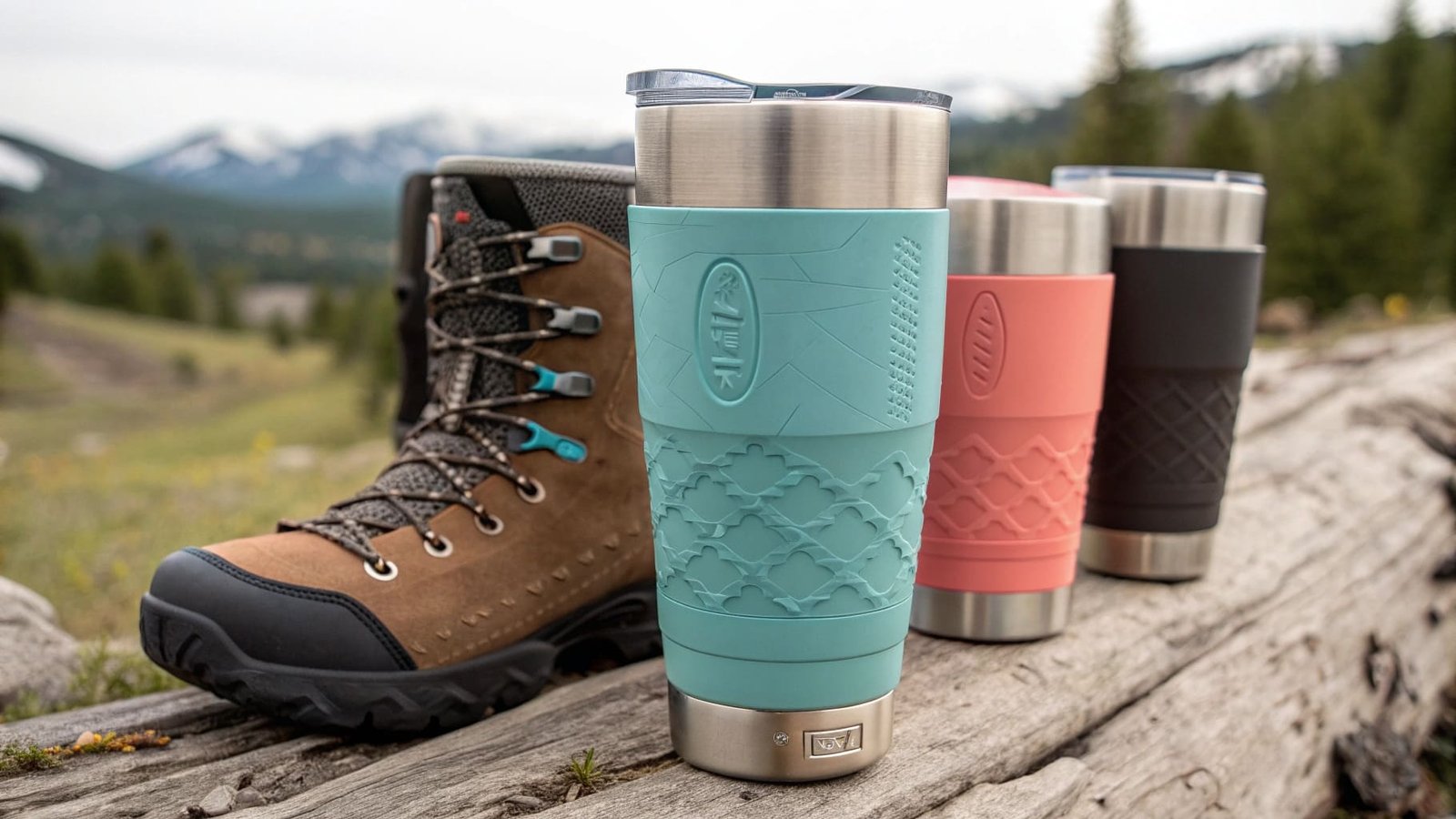
This is where silicone gives you a real competitive edge. Silicone can be molded into custom textures, grip patterns, and shapes that neoprene cannot replicate at the same quality level. You can create a sleeve that feels premium in the hand, carries your brand's visual identity, and still functions better than the competition.
For buyers who are rebranding products before distributing them — which is a common model in Canada and other Western markets — this design flexibility means your product looks and feels like it belongs at a higher price point. That is not a small thing. That is your margin.
What Is the Problem With Silicone?
I want to be straight with you here. Silicone is not a perfect material. If a supplier tells you it has no downsides, they are either uninformed or trying too hard to close the deal.
Silicone has real limitations. Knowing them upfront will help you plan your sourcing strategy better and avoid surprises later.
The goal of this section is not to talk you out of silicone. It is to give you an honest picture so you can make a decision with full information.
Is Silicone More Expensive Than Neoprene?
Yes. Silicone tumbler sleeves typically cost twenty to thirty percent more per unit than comparable neoprene sleeves. This is a real number that affects your unit economics, especially when you are buying in large quantities.
But cost per unit is only one part of the calculation. Here is how the full cost picture looks when you factor in the real-world variables:
| Cost Factor | Neoprene | Silicone |
|---|---|---|
| Unit price | Lower | Higher by 20–30% |
| Return rate | Higher | Lower |
| Product lifespan | Shorter | Longer |
| Certification compliance cost | Additional testing needed | Often included in food-grade specs |
| Reorder frequency from end customers | Lower | Higher |
When you map out the full picture, the silicone premium often pays for itself. But you need to run this calculation with your own margin structure and target market in mind.
Does Silicone Have a Grip Problem?
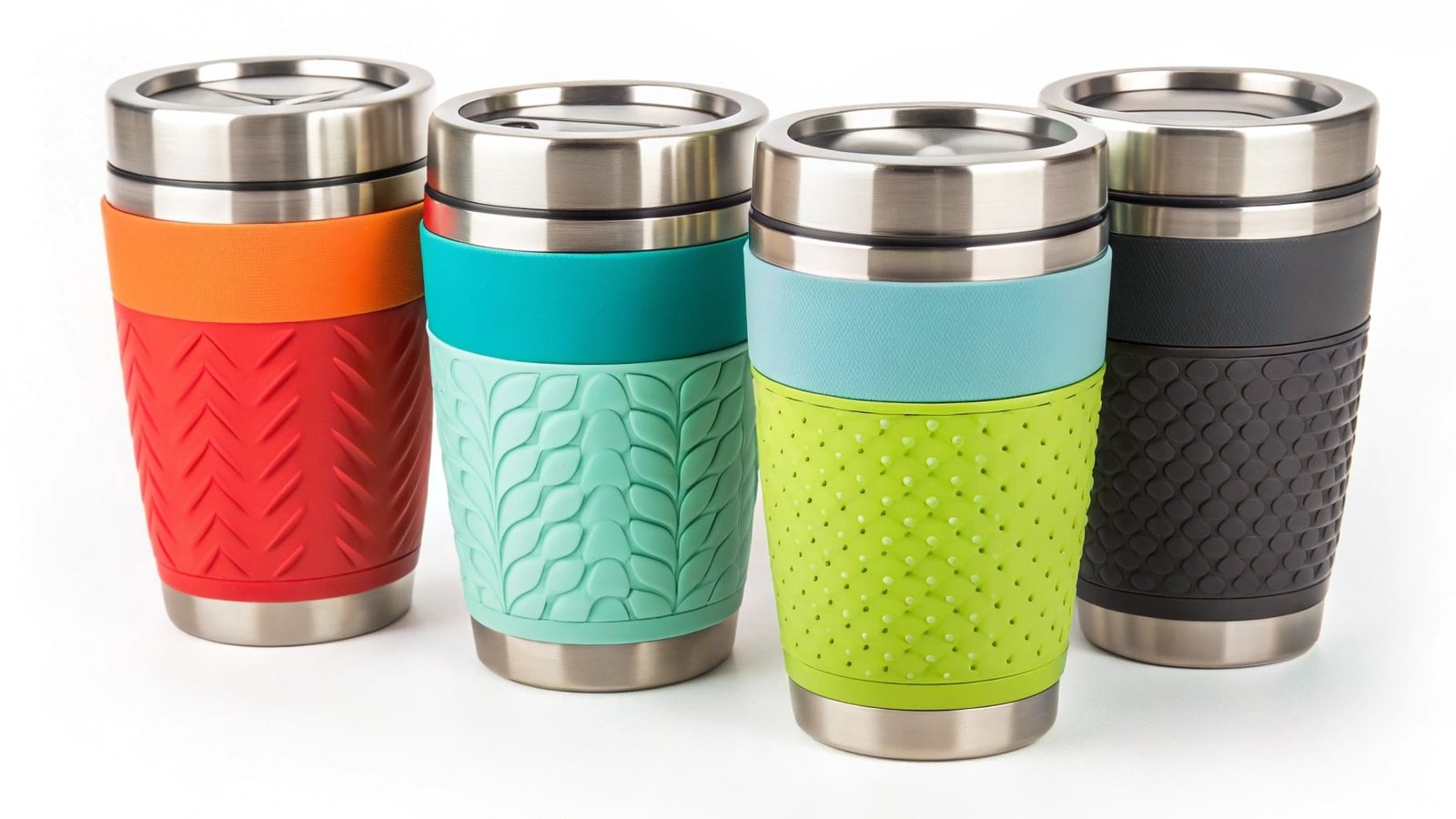
Silicone is naturally smooth. Without specific texturing or surface treatment during manufacturing, a silicone sleeve can feel slippery in the hand. This is a legitimate design challenge, especially for tumblers used in outdoor or athletic contexts.
The solution is straightforward — but it requires working with a manufacturer who has the capability to add grip textures during the molding process. Not all suppliers can do this well. When you are evaluating suppliers, ask specifically about their texturing options and request physical samples before placing an order.
Does Silicone Insulate as Well as Neoprene?
This depends on thickness. At standard thicknesses, neoprene has slightly better insulation properties than silicone.10 If insulation is a core feature of your product, you will either need to increase silicone thickness or accept a small performance difference.
For most tumbler applications, the insulation difference is small enough that customers do not notice it in daily use. But if your product is marketed specifically for temperature retention, this is worth testing with samples before you finalize your specs.
Is Quality Consistency a Risk With Silicone?
This is the most important limitation to understand. Not all silicone is equal. Lower-grade silicone contains fillers that reduce cost but also reduce durability, flexibility, and sometimes safety compliance. A supplier using filled silicone can still present a product that looks fine on the surface — until it fails in the field.
Here is what to check when evaluating silicone suppliers:
| Verification Step | Why It Matters |
|---|---|
| Request third-party lab test reports | Confirms material grade and certification validity |
| Ask for a white paper burn test | Pure silicone leaves white ash; filled silicone leaves black residue |
| Order samples before bulk purchase | Tests real-world performance, not spec sheets |
| Check supplier's production capacity | Capacity issues lead to delayed shipments |
| Confirm MOQ and mold ownership terms | Protects your custom design investment |
I have seen buyers lose a full season of sales because they skipped supplier verification and received a shipment that failed certification checks at customs. The cost of that mistake far exceeds whatever was saved on unit price.
Conclusion
Neoprene falls short on safety, durability, and market expectations. Silicone costs more upfront but delivers better returns, fewer complaints, and stronger brand positioning long-term.
-
"Chloroprene - Wikipedia", https://en.wikipedia.org/wiki/Chloroprene. A materials reference identifies neoprene as polychloroprene, a synthetic rubber produced by polymerization of chloroprene, supporting the article's description of neoprene as a chloroprene-based material. Evidence role: definition; source type: encyclopedia. Supports: Neoprene is polychloroprene, a synthetic rubber made by polymerizing chloroprene.. Scope note: The source can establish the chemical identity and production route, but it may not directly characterize all commercial chloroprene feedstocks as petroleum-derived. ↩
-
"Sustainable consumption - OECD", https://www.oecd.org/en/topics/sub-issues/sustainable-consumption.html. Institutional consumer research reports that environmental information and product attributes are among the factors consumers consider when evaluating purchases, providing contextual support for the claim that some consumers investigate what products are made from. Evidence role: general_support; source type: institution. Supports: Consumer research indicates that sustainability information and product composition can influence purchasing decisions.. Scope note: Such evidence supports a general consumer trend and may not measure tumbler-sleeve buyers specifically. ↩
-
"Responsible business conduct", https://www.oecd.org/en/topics/policy-issues/responsible-business-conduct.html. Institutional guidance on responsible and sustainable procurement documents the growing use of environmental and social criteria in supplier selection and supply-chain management, supporting the article's broader claim about retailer procurement expectations. Evidence role: general_support; source type: institution. Supports: Retail and supply-chain guidance increasingly incorporates sustainability requirements into procurement and supplier management.. Scope note: The evidence is contextual and may not document every major retailer or the specific drinkware-accessory category. ↩
-
"The Aging of Polymers under Electromagnetic Radiation - PMC", https://pmc.ncbi.nlm.nih.gov/articles/PMC10934588/. Polymer-aging studies describe ultraviolet exposure and chemical contact as factors that can accelerate oxidative degradation and cracking in elastomeric materials, offering mechanistic support for the article's warning about neoprene aging. Evidence role: mechanism; source type: paper. Supports: UV exposure and chemical contact can contribute to oxidative aging, cracking, or surface degradation in elastomers including polychloroprene.. Scope note: The evidence may address elastomers or polychloroprene generally rather than the exact geometry and use conditions of tumbler sleeves. ↩
-
"21 CFR 177.2600 -- Rubber articles intended for repeated use. - eCFR", https://www.ecfr.gov/current/title-21/chapter-I/subchapter-B/part-177/subpart-C/section-177.2600. Food-contact regulations and official guidance identify conditions under which rubber or silicone materials may be used in contact with food, supporting the claim that appropriately formulated food-grade silicone can meet FDA and LFGB-related requirements. Evidence role: definition; source type: government. Supports: Silicone rubber materials may be evaluated under food-contact rules such as FDA 21 CFR 177.2600 and European/German migration requirements.. Scope note: Regulatory sources establish possible compliance pathways; they do not prove that any particular supplier's silicone sleeve is compliant without product-specific test reports. ↩
-
"Food Packaging & Other Substances that Come in Contact with Food", https://www.fda.gov/food/food-ingredients-packaging/food-packaging-other-substances-come-contact-food-information-consumers. Government food-contact material guidance shows that the United States uses FDA food-contact rules and that European compliance is governed by EU framework legislation with national measures such as Germany's LFGB, contextualizing the article's emphasis on FDA and LFGB benchmarks. Evidence role: historical_context; source type: government. Supports: FDA rules govern food-contact materials in the United States, while EU and German LFGB-related requirements are commonly used in European food-contact compliance assessment.. Scope note: The source may not support the phrase 'two most important' as a ranked market claim and should clarify that LFGB is German law rather than a single EU-wide certification. ↩
-
"Regulatory Status of Components of a Food Contact Material - FDA", https://www.fda.gov/food/packaging-food-contact-substances-fcs/determining-regulatory-status-components-food-contact-material. Food-contact material regulations distinguish materials by composition and extractive limits, indicating that compliance must be demonstrated for the specific rubber formulation rather than assumed from use as a sleeve material. Evidence role: general_support; source type: government. Supports: Food-contact compliance depends on formulation and testing, and neoprene/polychloroprene is not interchangeable with food-grade silicone under food-contact requirements.. Scope note: This supports caution about neoprene compliance but may not prove that all neoprene products categorically fail FDA or LFGB requirements. ↩
-
"Study on the Synthesis and Thermal Stability of Silicone Resin ...", https://pmc.ncbi.nlm.nih.gov/articles/PMC7601899/. Materials-property references report that silicone elastomers retain useful flexibility and stability over a broad service-temperature range, commonly spanning subzero temperatures to above 200°C, supporting the article's temperature-performance claim. Evidence role: mechanism; source type: research. Supports: Silicone elastomers are known for thermal stability across low and high service temperatures.. Scope note: Published ranges vary by grade, additives, and test conditions, so the citation should not imply that every silicone sleeve will meet the same limits. ↩
-
"Microbial growth and adhesion of Escherichia coli in elastomeric ...", https://pmc.ncbi.nlm.nih.gov/articles/PMC10220030/. Microbiology and biomaterials studies indicate that silicone's non-porous structure limits internal microbial penetration, while also showing that bacterial adhesion or biofilm formation can occur on silicone surfaces when contamination and moisture are present. Evidence role: mechanism; source type: paper. Supports: Non-porous silicone limits internal penetration compared with porous materials, although bacteria can adhere to and form biofilms on surfaces under certain conditions.. Scope note: The source would qualify the article's absolute wording by supporting reduced internal growth rather than complete bacterial resistance. ↩
-
"Noble-gas-infused neoprene closed-cell foams achieving ultra-low ...", https://pmc.ncbi.nlm.nih.gov/articles/PMC9080917/. Thermal-property data for neoprene foam and silicone rubber show that insulating performance depends on structure and conductivity, with foamed neoprene commonly offering lower effective heat transfer than solid silicone at similar thicknesses. Evidence role: mechanism; source type: research. Supports: Neoprene foam's cellular structure and thermal conductivity can provide stronger insulation than solid silicone rubber at comparable thicknesses.. Scope note: The comparison is contextual because actual tumbler-sleeve insulation depends on sleeve geometry, density, thickness, and contact conditions. ↩